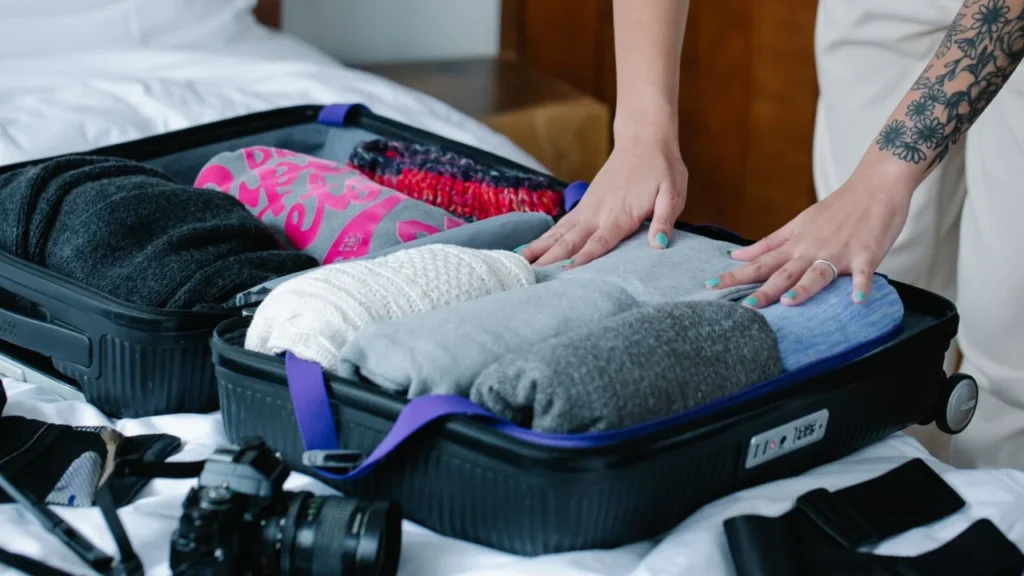
Choose compression packing cubes when soft clothes take up more depth than your bag allows. Choose regular cubes when you mostly want to keep things sorted and easy to reach. A second zipper can flatten some loads. Shoes, rigid items, and thick seams still take up room.
TL;DR
- Use regular cubes for clothes that already sit flat and for items you open the cube to reach often.
- Use compression for soft layers that have room to flatten. Close the main zipper before using the second zipper.
- Measure the thickest point after packing. A compressed cube can still bulge.
Compression packing cubes vs. regular cubes with the same load
Start with two tees, a thin fleece, lightweight pants, and three pairs each of socks and underwear. Fold everything the same way. Use cubes with similar footprints so you can compare depth.
| Same items | Regular cube | Compression cube |
|---|---|---|
| T-shirts and fleece | The stack keeps much of its folded depth. | The second zipper reduces available depth. Layers with more air can flatten more. |
| Socks and underwear | A small cube groups loose pieces and takes one zipper to open. | Useful if the stack has room to shrink. A tiny load may gain little. |
| Pants with thick seams | Lay the hard seams away from the same spot in the stack. | A hard seam can still create a bulge when the sides compress. |
| Shoes and rigid items | Place them alongside the cube if they fit. | Leave them outside the cube. A second zipper cannot shrink them. |
Measure the depth that matters
Eagle Creek lists the Reveal Compression Medium at 14 × 10 × 3 inches before compression and 14 × 10 × 1 inch compressed. Those are the maker’s cube dimensions. The thickness of your loaded cube depends on what is inside.
Suppose a bag half has 4 inches of depth, and a pouch on the other side occupies 1 inch at that spot. That leaves about 3 inches for the clothing cube where the two loads meet. If your regular cube measures 3.5 inches at its tallest point, check whether the same load closes comfortably in a compression cube within that 3-inch space. These measurements illustrate what to check at home.
- Load the regular cube and measure the highest point without pressing it down.
- Move the same clothes to the compression cube in the same order. Close the main zipper, then use the compression zipper if it moves freely.
- Measure again. Close the carry-on and check its outside dimensions, including any new bulges.
Which style makes sense for your bag?
The BAGAIL compression set illustrates the two-zipper design. Start with one cube for the softest clothes. If the bag already closes easily, a regular mesh cube may be enough. For footprint and layout examples, compare the carry-on packing cube sizes. Plan the clothing load with the short-trip checklist or one-week wardrobe plan.
Packing cube FAQs
Do compression cubes save luggage weight?
The clothes weigh the same and the cube adds its own weight. Check the packed bag against your airline’s limits.
Will compression cubes wrinkle clothes?
Tight packing can leave creases. Keep items that crease easily in a looser cube or lay them flat on top.
Can I mix the two kinds?
Yes. Use a compression cube for soft layers and a regular cube for items you take out often.


